
The public archive of ESVA: the Breach, the Ordem, the three clans, the Registro, the nine incursions and the Cavern. This document shows what happened. Never why.
In 1738 a royal charter founded the Royal Society of Correspondence and Natural Historiography — naturalists, cleric-scientists and overseas correspondents trading specimens, weather observations and expedition reports. An ordinary enterprise for the period. What set it apart was not in the public charter: it was a second correspondence, parallel and unrecorded, among a small inner circle who copied, dated and filed impossible reports.
The circle's thesis was modest and correct: reports that should not have resembled one another, coming from places with no way to exchange information, resembled one another. A sailor in the Indian Ocean and a backlands farmer described the same impossible anatomy thirty years and an ocean apart. That is not folklore being copied. It is observation repeating.
Among the reports was one the circle called, among themselves, the First Account — no firm date, no firm origin, copied from a copy of a copy, so old that two members argued by letter over whether it was genuine or an erudite forgery. This archive does not transcribe what it said, and not out of secrecy: no one in the circle agreed on what it said, and the few surviving transcriptions diverge on central points. The Ordem treats that as the first symptom, not the first fact — an account that changes every time it is read is not an account, it is an instrument.
On the night of 4 October 1751, in the coastal town the documents call only Salvaterra — a place name the Ordem treats as a deliberate codename, not a location on any map — the circle met to verify the First Account: to cross-reference dates, cross-reference descriptions, prove or disprove that all the reports were describing the same thing. It was the act of comparing, not the act of reading, that opened it.
What the three surviving witness versions agree on is little and verifiable: there was light where there should have been none, and cold where there should have been heat, and the reverse, at the same time, in different rooms of the same building; no fire and no source of cold were found afterwards. Of the fourteen members present, four died that night, three vanished and were never found — not alive, not dead, not in any death record — and seven survived. None of the seven agrees with another on how many things were in the room, whether it was one thing changing or several, or whether it left the building before dawn. That disagreement — formalised, filed and never resolved — is the most important record of the night.
The Ordem has an archival name for the night: the Collapse of Salvaterra. Not "opening", not "incident", not "discovery" — "Collapse", the vocabulary of a structure giving way, because that is what the survivors actually witnessed: an institution of fourteen people ceased to exist in one night. One of the seven, identified in the records only by the initial V., wrote in a note handed to a messenger the next morning the line that is now the founding premise:
We opened nothing. It was already ajar when we arrived. We simply looked too closely.
What crossed does not decay under our physics; our physics decays around it. An esva is victim and disaster at once — not evil, not corrupted, simply compatible with rules that are not ours.
This archive does not explain the mechanism of the Breach. Not because the information is locked in some vault: because the Ordem, after nearly three centuries of measurement, never obtained it.
The public Society did not learn of that night for three years. The circle hid the disaster from the very institution that housed it — first out of fear of ridicule, then fear of investigation, then because hiding had worked so far, and working once looks like proof. For three years, unsupervised and reviewed by no one, the seven survivors tried to contain what had crossed by themselves, and multiplied the damage trying to conceal it.
When an eighth name, from outside the original circle, found the archive and threatened to publish it himself, the seven realised they had two options: kill the discovery, or found something on top of it. They chose to found. The condition the eighth imposed — publish everything, always, forever — is the Ordem to this day.
The founding letter is dated 1754. It never uses the word "science" or "discovery". It uses, thirteen times across four pages, the word debt.
We were not betrayed by a force we did not understand. We were betrayed by the very secret we swore to keep.
Everything the Ordem is today comes from that. It publishes the entire Registro, including wrong entries kept alongside the refutations that brought them down. It publishes the arithmetic that guides containment — because the Society died trying to work the math alone, with no one to check it. It names whoever confirmed first. This is not virtue: it is the specific penance for a specific kind of harm, and it is meant to sting.
No official document of the Ordem attributes its founding to a person. That is doctrine, not modesty: the Society fell because a small circle trusted itself too much, and to centralise credit is to centralise decision. The top of the institution is not a command post — it is a process. And that is why you, if you play, are not a chosen hero: you are an initiate, a hire who inherits a debt.
An Archivist is not a mentor; an Archivist is a librarian. There is one per field post and never a central one, so that no single person can again be the archive's only point of failure. Curators keep the stations and assess credentials in combat — the duel is not the prize, it is the measuring instrument. And at the top sits the Censor, the magistrate who presides over peer review and may strike an entry from the Registro, including one that has stood for decades. The title is a Roman office — the Censor kept the census and could strike a citizen from the rolls — and the discomfort it causes is deliberate too: the institution whose sin was concealment chose, for its own summit, a word that reminds everyone that oversight has a price. Nobody "wins" the top of the Ordem: the final confrontation is not a fight against the Censor, it is a submission he presides over, judged by three clans that attack from different angles — because in 1751 there was no one attacking from any angle at all.
The clans are not personality teams. They are three divergent testimonies of the same night, stretched across generations of people who kept disagreeing for the same reason.
Índice descends from the survivor who stopped to count before fleeing. It keeps the Registro, and treats the question "what does this mean" as a reopening of the exact question that killed fourteen people. "I do not know what I saw. I know I saw seven. That is all I can swear to."
Vigília descends from the survivor who swore, until he died, that what crossed looked at him before it left. The other six never confirmed it. He never backed down. Vigília accepts every number Índice produces and disagrees on one thing only, the same one as two and a half centuries ago — that the door opened by accident. They are the Ordem's best observers precisely because they start from the premise that there is something to see. "Índice says there is no message. I asked how it knows. Did it measure?"
Raiz was not born from the night; it was born from the morning after, when the survivors found that one of the vanished had been feeding something for months, hidden from the rest of the circle — something merely alive in a way that should not have been possible, and completely tame. Raiz works less with containment and more with cultivation and lineage; the other two accuse it of sentimentality, and it answers with specimen-survival numbers, which are better. "You spent a hundred years cataloguing visitors. I spent ten learning to feed one."
None of the three is right. None is wrong. It is real philosophy of science dressed as a faction: positivism, theology and naturalism arguing over the same night for more than two hundred years with no new data to break the tie. The day one of them decisively wins is the day the Ordem stops needing peer review — and the whole institution exists so that day never arrives.
A class does not describe what a creature is made of. It describes the physical law it violates. There are thirteen, and the Ordem uses them the way it uses any other unit of measurement: so it can say, in one sentence, exactly what stopped working.
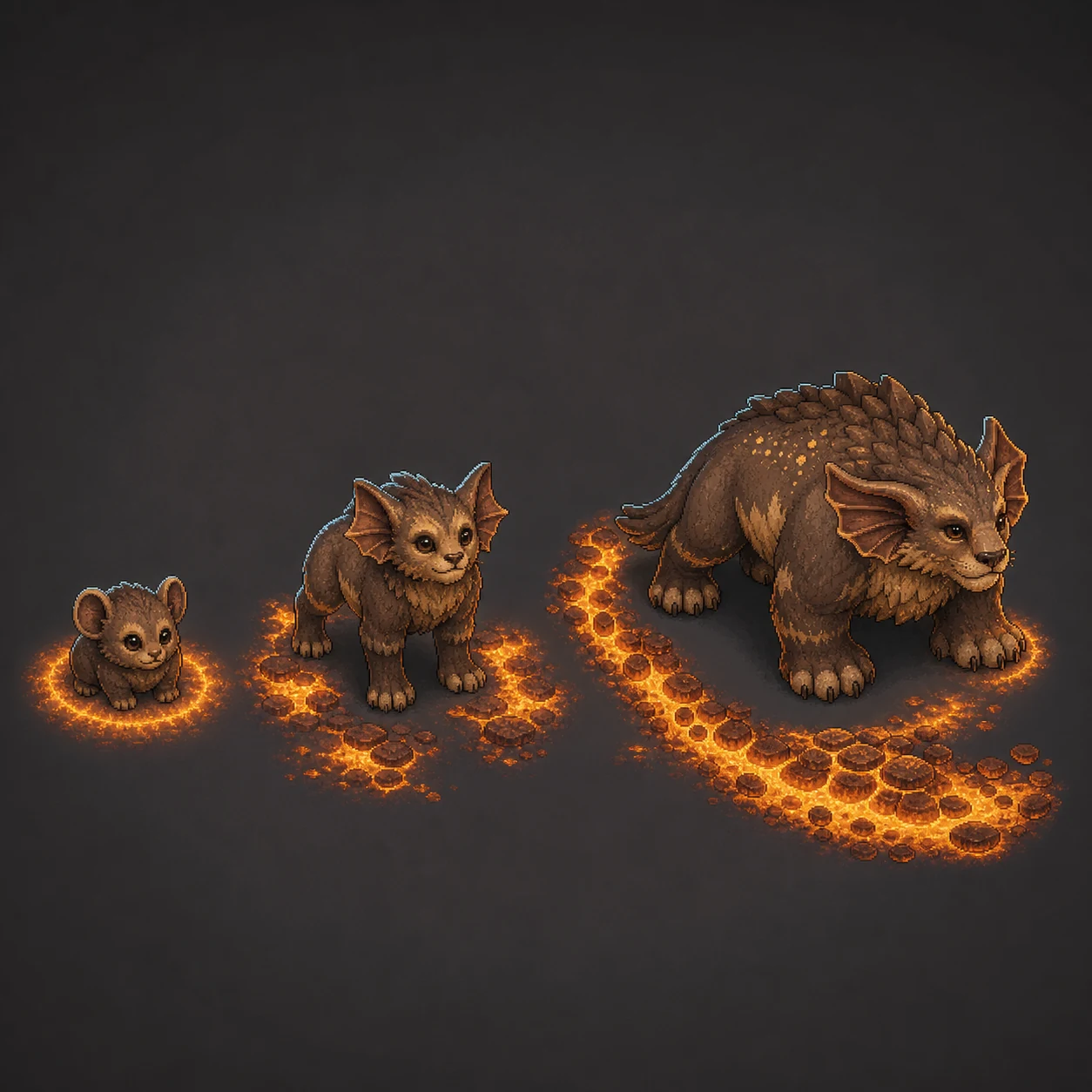
ÍGNEO — thermal emission without source or fuel.
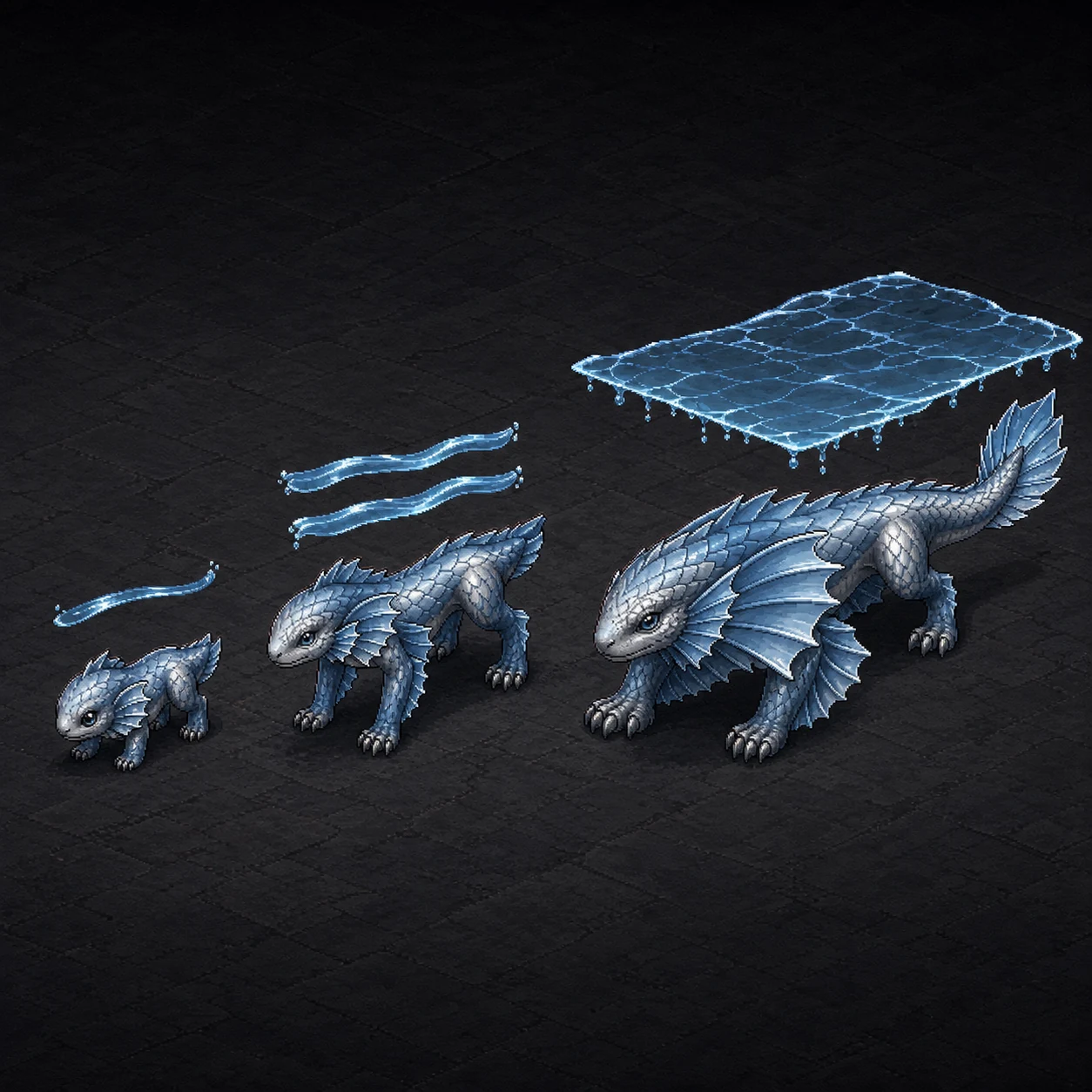
HIDRO — fluid behaviour outside the rules of phase and volume.
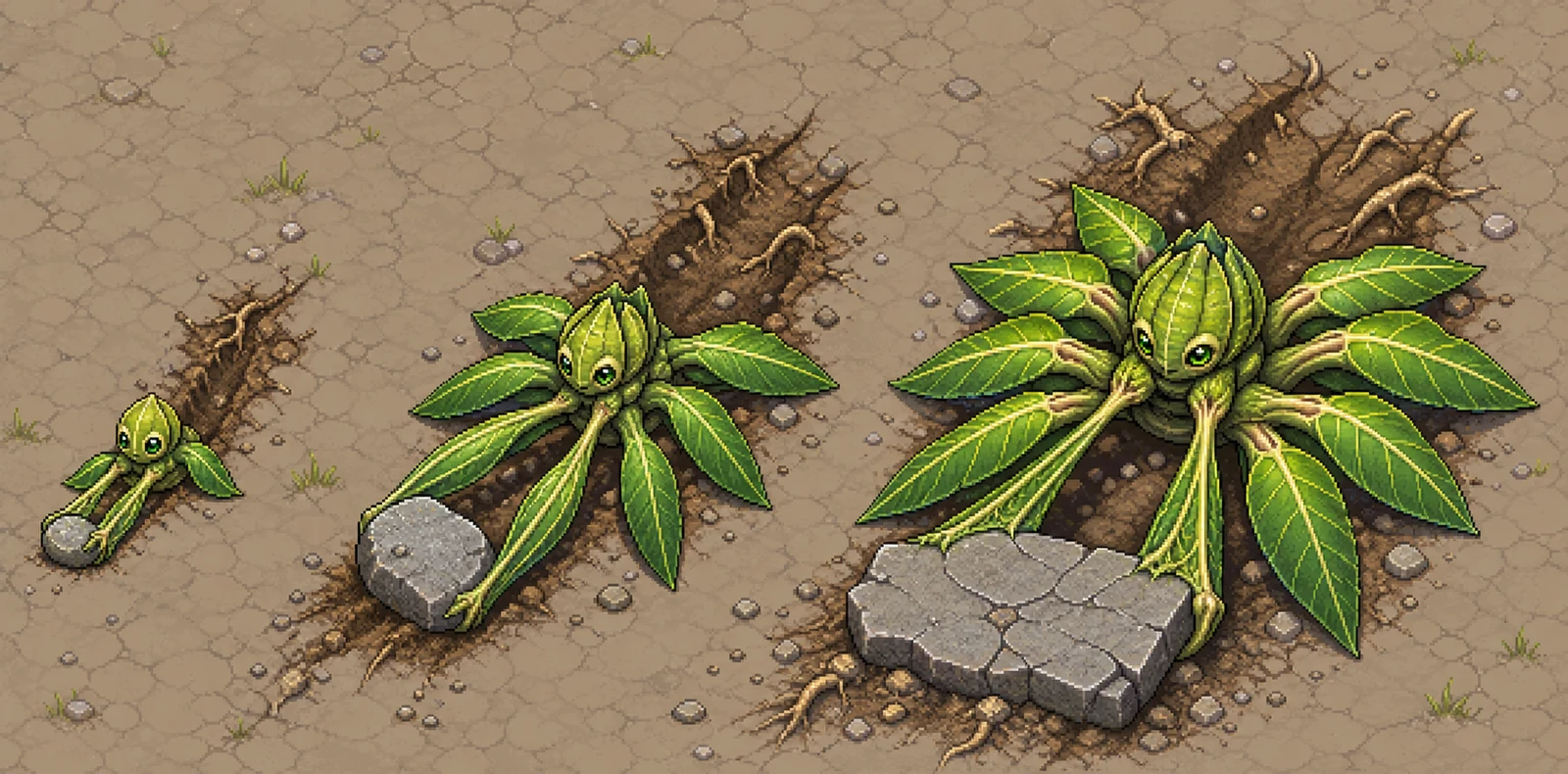
FLORA — metabolism or growth impossible for its rate or substrate.
CARGA — electrical potential without circuit or conservation.
CRIO — energy removed with no exchanger; thermal order reversed.
CINÉTICO — impulse, inertia and force transfer outside conservation; motion without matching reaction.
GEO — mineral mass, crystal structure and cohesion outside the rule.
AERO — lift and pressure with no geometry to justify them.
NEURAL — non-local action: it acts where it is not.
UMBRA — solidity, phase and optics all wrong.
TÓXICO — chemical reaction that ignores mass, dose and barrier.
VETOR — distributed coordination with no channel of communication.
TEMPO — sequence, cadence and causality out of order.
There is no neutral class, and the reason is canon: a creature that breaks no rule is not an esva. When a specimen carries two classes the reading stays the same — the primary is the broken rule, the secondary is the base, the body it was before it violated anything.
There are two layers and they never cross. The Registro da Ordem is global and permanent: everything the whole institution has confirmed, with the name of whoever confirmed it first. The Field Notebook is personal and progressive: what that one initiate has seen with their own eyes — and it is the same thing as the analysis interface, because the UI and the lore are not two things. Seeing is not having, and having is not confirming.
A Registro entry is neither biography nor flavour text. It is a report: formal designation, field name, class, the broken rule described with figure and unit, the state of the entry, the First Case, published incidence, the historical account cited with date, place and witness, and the containment protocol written in impersonal voice.
The formal designation is a coinage of the Ordem's own, identical in every language — Zimra · Ferune · Talvora is the same line in English, Portuguese or Spanish. The field name is the other thing: either a short coinage, for species with no historical testimony attached, or a citation — and a citation stays in its language of origin, untranslated, because it is a quotation and not a label.
No field is ever left blank. Where there is no data, the absence is written down: "none recorded", "not preserved", "not calibrated". An empty field would communicate zero; a field that reads "not preserved" communicates that the Ordem looked and did not find — which is itself information. In the Ordem's doctrine, presence communicates; absence does not. It is the same discipline of publishing even what shames you, applied to a single line.
What the Ordem never closed has its own name: the Open Case. An entry that stays Apocryphal, unconfirmed in any review, by decision of peer review and not for lack of trying. It stays in the Registro as a standing question, treated as data and never as a gap to be filled with conjecture.
And that is how the Ordem grants the only immortality it has: the First Case, the name of whoever confirmed a species first, engraved in the entry forever. Others confirm later; the historical credit does not move. Not for convenience, not out of pity. The Ordem reviews and, when it errs, corrects the entry — never the credit.
The Ordem works from the hypothesis that myth, folklore and theology are the record of earlier breaches — that the creatures were never supernatural, and that those who saw them had no vocabulary for physical violation, only vocabulary for haunting. It is a hypothesis. Never a fact. Each incursion's identity is its dominant physical law, described without naming the country; the culture is only the provenance of the account, the lens, never the quota. And the hypothesis grows more complicated with every incursion: each deepening costs the Ordem a certainty, and whoever walks all nine ends up knowing less, with more confidence, than they knew going in.
The baseline, where the method was calibrated with no cultural lens: relatively stable territory, catalogued since the founding. This is where the first three public families live — Zimra, Oryn and Brin — and it is the closest thing to "safe" the Ordem has. Most species here are generic fauna with no folklore testimony behind them, and it is right that they are: not every species needs a myth.
Heat without a source and biomass without observable substrate, measured far from any coast. The raw material is recent rural testimony, often from a single person, often never corroborated. This is where the hypothesis is born — and where the "Mula Sem Cabeça" enters the global Registro with a date, a provenance and the name of whoever confirmed it. It also leaves the arc's quietest Open Case: an entry with no field name, because the only witness died before repeating the account to anyone else.
Geometry and action that do not respect distance. The Ordem strips away artistic convention and reads the angelological text literally — Ophanim, Seraphim, Cherubim, Thrones. It holds that those accounts could describe specimens of an uncatalogued incursion. It holds it as a reading, not as fact: the divine enters dismantled, not canonised — the Ordem does not prove the divine exists, it holds that what was called divine had mass. No species is capturable under a literal biblical name. It opens an Open Case read as Thrones: wheels of fire, consistent across multiple traditions, never sighted under containment conditions.
Proportion and scale exceeding what anatomy should sustain. From the tradition of the far north the Ordem extracts an unexpected datum: numerical precision. "Eight legs", not "many legs". It learns that an account can be precise data — and loses the certainty of being the first institution to take this seriously. The Open Case it opens is about scale, not danger: a body that encircles whole territory, whose far end was never seen by the same witness who saw the head.
Tissue that refuses to decay; time that stops passing at one point of a body. The Ordem reads ancient iconography as a system for communicating attributes rather than anatomy — and runs into the most uncomfortable suspicion of the arc so far: that it is reading the archive of a sister institution, dead for millennia, which reached the same solution and left no one alive to explain why. The Open Case is read from the mythological antagonist of the sun: a recurrence described as daily and eternal, never contained, never refuted.
Tissue that changes kingdom — plant, animal, mineral — with no intermediate step. Beneath the metamorphosis accounts the Ordem's reading is cold: there was no transformation, there was a substitution witnessed by someone who emotionally needed it to be the same person. It is the first time the method carries an explicit moral cost with no solution, and the only time Vigília and Raiz unite against Índice. Índice does not back down: "we catalogue what is left; mourning what did not survive is the work of whoever told the story before us".
An object that, on completing a fixed interval of time, acquires a metabolism. It is the closest thing to a measurable law the Ordem has ever catalogued — and the thing that breaks the boundary: if a manufactured object can violate physics the way a body does, "creature" stops being the stable category everyone assumed. The Open Case is about the Ordem's own dating method failing: it is not the creature that resists, it is the archive that cannot bear the weight of the question.
A distributed body: many points acting as a single consciousness, with no visible channel. This is the incursion where the Ordem admits, without hedging, the conclusion that had been forming for a while — we are not the first to attempt this. At best, we are the most recent. The central reading is of an old account of a beast that catalogued and dictated, to a central power, an immense number of known creatures — the oldest existing description of an institution just like this one: a Registro that walks. What became of the earlier ones, the Ordem does not know.
The most recent case, the most instrumented — and the only one the Ordem has never closed. Photography, radar and a living witness are not enough to confirm what a two-century-old account was enough to accept. The founding hypothesis is not refuted: it is exposed as unfalsifiable. The Ordem carries on anyway, because to stop cataloguing would be to go back to deciding alone, in silence. Its flagship case is handled with no brand name: a large aquatic specimen, witnessed for decades in the same body of water, photographed many times at quality insufficient for confirmation, never contained, never disproven with certainty.
There is one Breach — the founding wound of 1751, which never fully closed and reappears, not in the same place, not wearing the same face. And there are the breaches, minute ones: the points where it leaks into the measured world.
A breach is not a hole in the ground. It is a fold. On this side the world obeys the physics the Ordem knows how to measure; past the threshold, the physics is the anomaly's. Those who crossed and came back do not describe "another place" — they describe this place with the rules swapped. It is the same failure of language that founded the institution's entire lexicon.
For more than two and a half centuries the Ordem treated a breach as something to measure from the outside: contain, catalogue, close when forced to. The Expeditions mark the turn — crossing the threshold, stabilising a measurement field on the other side and returning with raw data stopped being a witness's accident and became a method. And, as every time the Ordem looks more closely, what it observes widens.
There are nine breaches, one anchored to each incursion, and here is the heart of it: the incursion is the measured reading of that world; the breach is the unmeasured thing that culture was trying to describe when it had only the vocabulary of haunting. The incursion measures the angelic and the demonic as catalogued specimens; the matching breach is heaven and hell in one room, with no theology and no explanation. The incursion measures the boreal margin; the breach is eternal ice crusted with living lava. A drowned desert. Marble that breathes. Contradiction coexisting in peace.
A breach is not stable. The deeper you go, the more the fold answers back — that is not staged difficulty, it is the breach reacting to observation, exactly as the founding premise says it does. What crosses back, crosses measured. Run modifiers end at the exit because a modifier is not matter — it is a state the breach imposes on whoever stands inside it, and a state ends when the anomaly does. Raw breach material does not circulate either, but that is doctrine, not physics: the Ordem does not release what it has not yet measured. Esvas cross and endure precisely because they were catalogued — which is why cataloguing is this Ordem's central act, not a collector's footnote.
A dark place, deep, and full of esvas that should not be together.
That was the first anomaly the Ordem recorded down there: species of different classes — which in the field ignore or fight each other — coexisting without conflict. They do not form a pack. They do not hunt. They stay. And when someone descends, they react as a single thing, with a coordination none of them shows on the surface.
They are protecting something. At the bottom lies an unknown chemical reagent that does not belong here: it came out of the Breaches. It is the material the Ordem calls Rupture Reagent — the only substance able to break an esva's form. It cannot be synthesised, it does not drop in the field, no raid and no extraction produces it. It exists only down there, and it only leaves if someone carries it out.
Incompatible species in stable coexistence. Cause: unknown. Object of the behaviour: identified, not understood.
Nobody knows what the reagent is. Nobody knows why the esvas guard it — whether it is instinct, attraction, or an order from something no one has seen. The Ordem measured, catalogued the behaviour, and stopped at the door of the question, as it always does. The deeper you go, the more concentrated the material and the more cohesive the defence: it matches whoever descends.
The Ordem is made of employees, not heroes. None of them holds any power beyond that of their own job.
The librarian of your home post. She hands over the Field Notebook, witnesses the Primeiro Registro and remains the constant voice of the Institute. She corrects an initiate's expectations — they arrive expecting a teacher — in her first sentence: "I am not here to teach you what an esva is. Nobody knows what an esva is. I am here to give you a notebook and show you where to file what you find."
He keeps the first station. He is not defending a title: he is measuring. While he fights he reads flask handling, notebook discipline and whether the initiate can survive what comes next. "I am not here to lose to you — I am here to tell you that you will not get yourself killed out there. Yet."
She keeps an advanced station and proved what nobody wanted proved: that a minor breach can be closed — and that closing it cuts off that station's source of material. The institution that exists to contain the Breach also depends on it. Ossuna is the one who hands that conflict back to the initiate to resolve.
She is not with the Ordem. For six years she was an estate assessor — the clerk who assigns value to what a dead initiate left behind. Today she runs the trading counter. Dry, never cruel, and the only character in the game who talks about money without embarrassment: "The Ordem tells you what the thing is. I tell you what someone will pay for it. Both are true and they are almost never the same number."
He runs the post's item shop: flasks, supplies, whatever you take before heading out. His counter is where doctrine meets logistics — the Ordem does not manufacture surplus, it redistributes what is left over, and Bastos is the one who knows exactly what is left.
He presides over peer review and may strike an entry from the Registro, including one that has stood for decades. He does not fight, does not carry a satchel, commands no one: he decides whether a submission survives the scrutiny of the three clans. The office is neither inherited nor appointed — it is review, and the institution outlives the person.
The Ordem's field vocabulary. Not manual jargon: it is how the institution learned to name things that had no name. Every term comes from field science or institutional bureaucracy — never from fantasy. If it sounds like a magic stone, a gym or a badge, it is wrong; if it sounds like something a lab or an archive would say, it is right.
What crossed. A recognisable base with one broken physical rule. Not evil, not corrupted — simply compatible with rules that are not ours.
The fold through which the unmeasured leaks. It was always ajar; observing it widened it. Nobody can explain the mechanism, and the Ordem does not pretend to.
An entire measured world: a universe leaking through one coherent incompatibility, with its own law, light, materials and decay, mapped in quadrants. There are nine. A new incursion is not the end: the door does not close, it moves and comes back stronger.
The act of closing a specimen into a flask and turning it into an entry. You do not collect: you contain damage in progress. It is rare, it is slow, and the Ordem publishes the arithmetic behind it — even when the arithmetic does not flatter it.
Laboratory glassware, scaled up to reinforced or sealed as difficulty demands. You do not throw the flask: you calibrate it to the specimen's rules. The ZERO FLASK is the only one with no margin of error, and by doctrine it is never sold.
A manifestation amplified beyond the species' normal range: an anomaly inside the anomaly. The term comes from standard deviation. The entry describes the excess with the same precision as the base entry, never by vague comparison.
The margin of error that guarantees a specimen's appearance — never its possession. The Ordem publishes where the margin sits; it does not promise an outcome.
Raising lineage instead of cataloguing. It is the only activity of the Ordem that never opens an Open Case: it is not about discovery, it is about maintaining life already known.
The deepening of the same broken rule across a family's stages — the rule diverges rather than grows. The Deriva expands the contradiction; it never adds a second one.
Chemistry, not mineralogy. The input that pushes the Deriva. For instants, and only under extreme conditions, the same pressure is called rupture.
The mark the Registro gives the specimen rather than the species: how far that individual departs from the measured standard of its own kind.
A field instrument fitted to an esva. The Ordem does not manufacture surplus — it redistributes what is left by those who quit, died or retired from the field. Nothing is made to look new.
Research infrastructure, not an arena. Whoever keeps it is a curator: he assesses you in combat and grants a credential, which is access, not a trophy.
The Ordem's forward shelter, where the Archivist, the shop and the counter sit. The acervo is where an archive stores its pieces.
The esvas in use. It is what crosses with you from one incursion into the next, and it never resets.
The name of whoever confirmed a species first, engraved in the entry forever. Others confirm later; the historical credit does not move.
The entry that scrutiny never closed. It stays in the Registro as a standing question, not as a gap to be filled with conjecture.
The state of an entry not yet confirmed. A blank page in the Field Notebook is not a system error — it is information.
The mechanism of the Breach is not here, and it will not appear in any document the Ordem signs. This is not managed suspense: it is the one point where the premise is absolute. If the Breach is explained, it stops being the Breach.
The names of the seven survivors and of the eighth founder are not here either. That is the Ordem's own doctrine, not an omission of ours — naming a founder would repeat the exact error that killed it. To give a genius a face is to centralise decision, and it was an unreviewed decision that opened the Breach. Writing "seven survivors, anonymous by doctrine" is the lore, not the absence of it.
The species of incursions 4 through 9 are not listed either: their authorship is still open, and publishing a species too early would fix it forever and hobble whoever authors it later. The Ordem prefers, here as in every Registro entry, the documented gap to an answer invented just to fill space.
And everything this archive says the Ordem "believes", "reads" or "holds" is a hypothesis, marked as such. No line here claims that a religious tradition or a folk story was an esva. The Ordem reads; the Ordem can be wrong; and the wrong reading, documented in public, is the most valuable material in the archive.
It is the same discipline as the whole arc, and it is the answer to the only question that matters about this institution: whoever walks all nine incursions discovers that the Ordem is, in several senses, the villain of its own story — and keeps wanting to work for it. They keep going because the Ordem never hides its own guilt: it shows the Collapse, it shows the incursion that erases a person from their own legend, it shows the incursion that reveals institutions just like it have already vanished, it shows the incursion that confesses its own method was never verifiable. And it shows all of that in public, in writing, signed — because it was founded on the discovery that hiding kills people. The alternative to working for a guilty, transparent institution is returning to the world before 1754: the world where seven people kept a secret on their own until it killed them.
This archive is fiction. Names, dates and place names are invention — "Salvaterra" is a deliberate codename and appears on no map. Game odds, rates and caps do not live here: they live in the devblog and in the public Field Notebook, where they belong. Precision in mechanics; mystery in fiction.